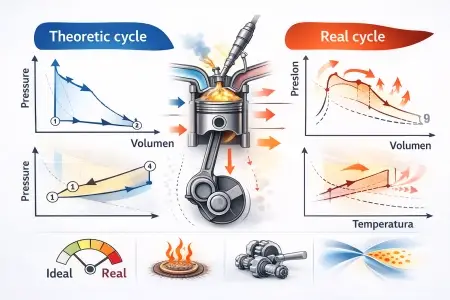
Diesel engines, with compression ignition, present significant differences between the theoretical cycle and the real cycle, both in shape and in pressure and temperature values. These differences, although similar to those observed in Otto cycle engines, have their own characteristics derived from the combustion process, gas dynamics and the mechanical configuration of the engine.
Some similarities with the Otto cycle are due to common phenomena, such as variation in specific heats, heat losses through the cylinder walls, and exhaust valve opening time. Other differences are particular to diesel engines, such as the influence of chemical dissociation of combustion products and pumping losses. A unique feature of the diesel engine is that combustion does not occur at constant pressure in the actual cycle, unlike what the theoretical model assumes.
Differences in four-stroke engines
1. Constant vs. variable pressure combustion
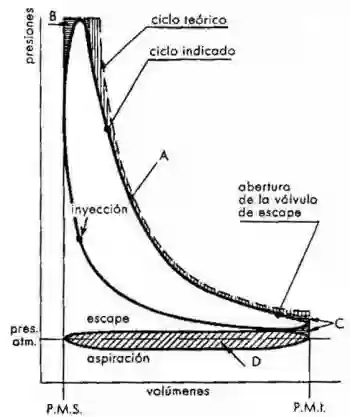
In the theoretical diesel cycle, combustion is considered to be at constant pressure. However, in practice, the pressure inside the cylinder varies throughout the combustion process. In reality, some of the combustion occurs at near-constant volume and some of it occurs at nearly constant pressure, similar to what happens in the real Otto cycle. Only in very slow-speed engines does combustion approach the ideal conditions of the theoretical cycle.
This pressure variation directly affects the pressure-volume curve of the cylinder, decreasing the thermal efficiency with respect to the idealized theoretical cycle.
2. Decoupling of combustion products
The chemical dissociation of fuel gases is less relevant in diesel engines than in gasoline engines. The excess air characteristic of diesel engines helps to reduce the maximum temperature of the gases, and therefore decreases the decomposition of the molecules. This has implications for efficiency and emissions: lower temperatures reduce NOx formation, although particulate emissions may increase slightly.
3. Pumping losses
Pumping losses, i.e. the work the engine must do to draw in air and exhaust gases, are lower in diesel engines than in Otto engines. This is mainly due to the absence of the air throttling characteristic of petrol engine carburetors. Without a throttle valve, the air enters more freely, and the negative surface area of the actual cycle (area under the pressure-volume curve corresponding to the pumping work) is smaller than in an equivalent Otto cycle engine.
Differences in two-stroke engines
Two-stroke diesel engines are common in applications such as heavy machinery, boats, and stationary generators. Although they share many features with four-stroke engines, they have additional particularities:
-
Most relevant pumping losses:
The work required for air intake and exhaust is greater, as the exhaust occurs before the expansion has completed its journey to the bottom dead center (PMI). -
Cylinder Sweep:
Cylinder cleaning is often carried out with the help of a compressor or turbocharger. This process, known as "scavenging", generates an additional contribution to the pumping work that must be considered in the energy balance of the engine. -
Effects on combustion and efficiency:
The need to complete the cycle in less time makes combustion less ideal, with more irregular pressure curves and slightly lower thermal efficiency than four-stroke engines.
Conclusion
The differences between the theoretical and actual cycle of a diesel engine are multifactorial and include aspects of combustion, mechanical losses and chemical effects. Understanding these differences is critical to engine design, optimization, and diagnostics, especially in applications that require high efficiency and low emissions. In both four-stroke and two-stroke engines, the effects of variable pressure, dissociation and pumping losses decisively condition the actual behavior of the engine with respect to the theoretical model.